
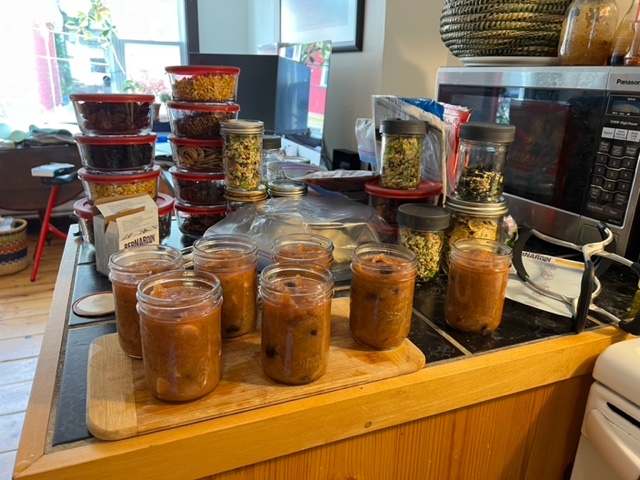
Rhubarb chutney ready for canning
With a mounting to-do list, I really didn’t need to add making rhubarb chutney and pickling burdock root to my day but I had no choice really. With garden fresh produce calling for my attention and with a limited window of freshness, Marian and I had to jump into food preservation before tackling kayak tune-ups and food preparation for our upcoming All Around the Circle expedition. As we scrubbed, chopped, cooked, packed in jars, brined, and water-canned our preserves, I thought about the guiding tune for our upcoming expedition, I’s the B’y. The lyrics of the first verse,
Sods and rinds to cover your flake,
Cake and tea for supper
Cod fish in the spring of the year,
Fried in maggoty butter
reflect the focus of spring and summer at the time the song was written around the 1880’s. Necessarily, spring and summer were a time for fishing and preserving cod fish, putting in gardens, and then harvesting and preserving those crops as they came ready. Now, nearly 150 years later, we were doing the same. Whenever I wonder about the origin or meaning of a word in a Newfoundland or Labrador folks one, I consult the Dictionary of Newfoundland English. In the 1880’s, cod fish in Newfoundland were preserved by salting and then drying them on a flake, a raised platform built near the shore. The flake had an airy stricture covered in boughs that allowed the fish to lie flat to dry in the sun. Drying the fish well took considerable care and attention and the fish had to be covered by sods and rinds (tree bark) to protect them from inclement weather.
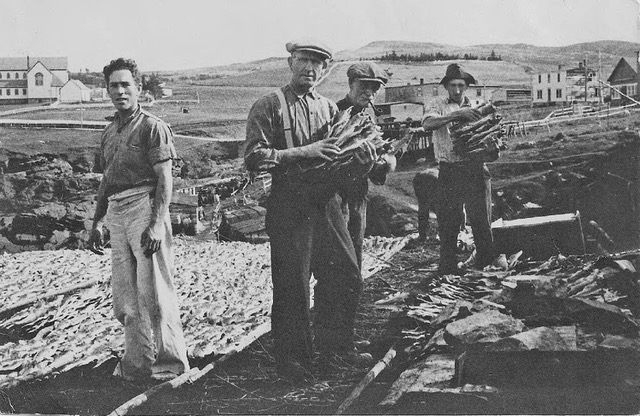
Collecting fish at Ryan’s Flake. (from the Memorial University Digital Archives Initiative from the collection of Roy Noseworthy).
Cake in the lyrics refers to hard tack or dry ship’s biscuit. It was and still is a way to travel remotely over sea or land with a sturdy form of carbohydrate. Purity manufactures it in two versions, the traditional used to make the classic Newfoundland dish, Fish and Brewis, and Sweet Bread-a sweeter more trail-friendly version. I’ve spent much of this week drying food for out expedition: berries, veggies, legumes, and meat. Drying makes it possible to carry them in our sea kayaks-it both keeps them from spoiling as well as reduces their volume considerably. It takes work but We appreciate eating real food while in the field. When we prepared for our three-month canoe expedition from Jasper to Tuktoyaktuk, we ran 2 food dehydrators 24/7 for a week!
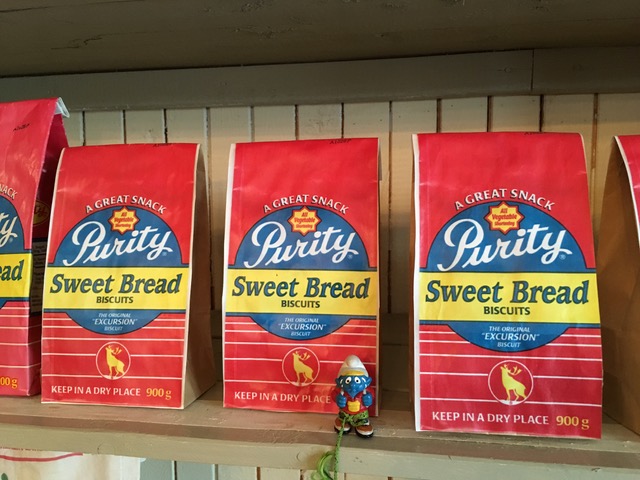
Bags of Purity Sweet Bread (photographed in the Labrador Heritage Society Museum in Northwest River, Labrador)
Maggoty means being full of maggots (the larvae of blow-flies)–the result of improperly cured fish or meat. It is also used to describe an area full of something-i.e. that cove is maggoty with black flies or that park is maggoty with people. Maggoty fish could spell disaster for a fishing family making it difficult to sell their catch or having enough food to eat. Food preservation is serious business-both now and then. We prepare our food for expeditions with great care so that we have plenty to eat, a key for health and safety. Speaking of which, I must get off the computer and get onto more trip preparations: more food drying, gear selection, map notations and the like! After COVID necessitated a break from bigger expeditions, it great to be back at it! Stay tuned and things are starting to get exciting! This expedition is supported by the Royal Canadian Geographical Society Expedition Grants program.


 TA Loeffler's Adventures that Move